


Key results
One of the largest digital consultancies in Central America
Loymark is part of Grupo Garnier, one of the largest communication groups in Central America. Five hundred people based in Costa Rica who run paid media and analytics for more than one hundred clients.
That means over 300 ad accounts across seven platforms: Meta, Google Ads, TikTok, LinkedIn Ads, DV360, GA4 and Search Console. Each one has a budget to hit, a client reading the report and an analyst answering for it. At that scale, data infrastructure stops being a back-office topic: the whole service leans on it.
Supermetrics moved the data. Sheets stored it. Nobody watched it.
Loymark ran on Supermetrics and Google Sheets. Supermetrics pulled each platform into a spreadsheet, and that's where the journey ended. One file per client, one analyst per file, and above all of that, nothing.
The data stopped at spreadsheets: nothing consolidated it and nothing watched it
A spreadsheet is a place to put numbers. It has no opinion about them. Nothing was going to warn anyone that a campaign had stopped spending: someone had to open the right file, on the right day, and notice.
A reactive team loses clients
With ten clients that stack works. With a hundred and more than 300 ad accounts, it becomes a tax on the whole team.
- Data scattered across a hundred spreadsheets. No single place to answer how a client is doing, and no way to compare one against another.
- Google Sheets was hitting its ceiling: 10 million cells. At the limit, the spreadsheet stops accepting rows. The team trimmed history and dimensions to make things fit, so every analysis ran on half the picture.
- One change had to be made a hundred times. Adding a metric or fixing a formula meant opening every client's file, one by one.
- AI had nothing to hold on to. Without a warehouse, no model could read the marketing data. Asking AI about an account produced made-up answers, because it wasn't connected to the real numbers.
- The team found out last. A paused campaign, a budget burning at double speed, ads cut off overnight: everything surfaced when the client called to ask, days later.
- And that was what drove churn. When the problem showed up in the monthly report, the client had already lost trust. Accounts walked away.
The problem was structural. The old stack had nowhere to fire an alarm from. The team was reactive because the system left it no other option.
A warehouse, a client map and alarms on top
Detrics led the migration end to end. We moved every ad account into Loymark's own BigQuery, consolidated the 100+ clients into a single data lake and put the alarm layer on top.
The platforms we connected


14 days, with the service running the whole time
Loymark kept Supermetrics active until the Detrics pipelines were already filling BigQuery and fully validated. The switch happened with the new infrastructure proven, so no client was ever left waiting for a report during the migration.
Connect the 300+ ad accounts across the 7 platforms and point them at Loymark's BigQuery project.
Consolidate every client into a single schema with a shared client map: one change applies to all of them.
Slack and email alarms, AI agents connected to the warehouse, old stack decommissioned.
What changed once the data lived in their BigQuery
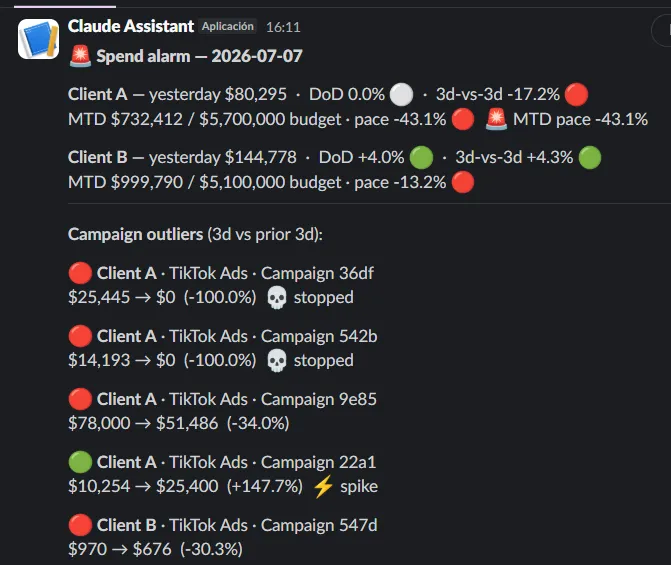
The Slack and email alarms fire on the delta between budget and actual spend. The team learns about a paused campaign or a runaway budget the same morning it happens, fixes it, and tells the client before the client asks. Accounts that used to slip away now stay.
One centralized data lake with every client inside. A metric change, a new dimension, a corrected formula: done once, applied everywhere. That gave each analyst back about 30% of the time they used to spend maintaining reports.
With the data in BigQuery, Loymark connected AI agents straight to the warehouse. Answers now come from each account's real numbers. The paid media team asks in plain language and gets the analysis and the report in minutes, instead of queueing the request with an analyst.
Detrics replaced Supermetrics and consolidated the 300+ accounts into Loymark's own BigQuery. Fewer per-platform licenses, more data capacity, and net savings of over USD 20,000 a year versus the previous stack.
The team finds out before the client does
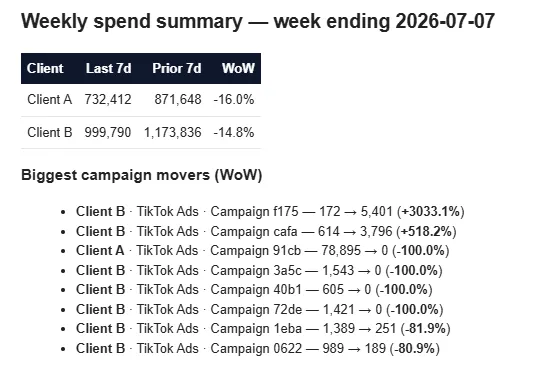
Every morning, before anyone opens a dashboard, the alarm is already in the team's channel and inbox: spend per client, daily variation, month-to-date against budget and the campaigns that stopped or spiked.
Want the same setup for your agency?
We lead the migration. Your data lives in your own BigQuery, with alarms on top.
